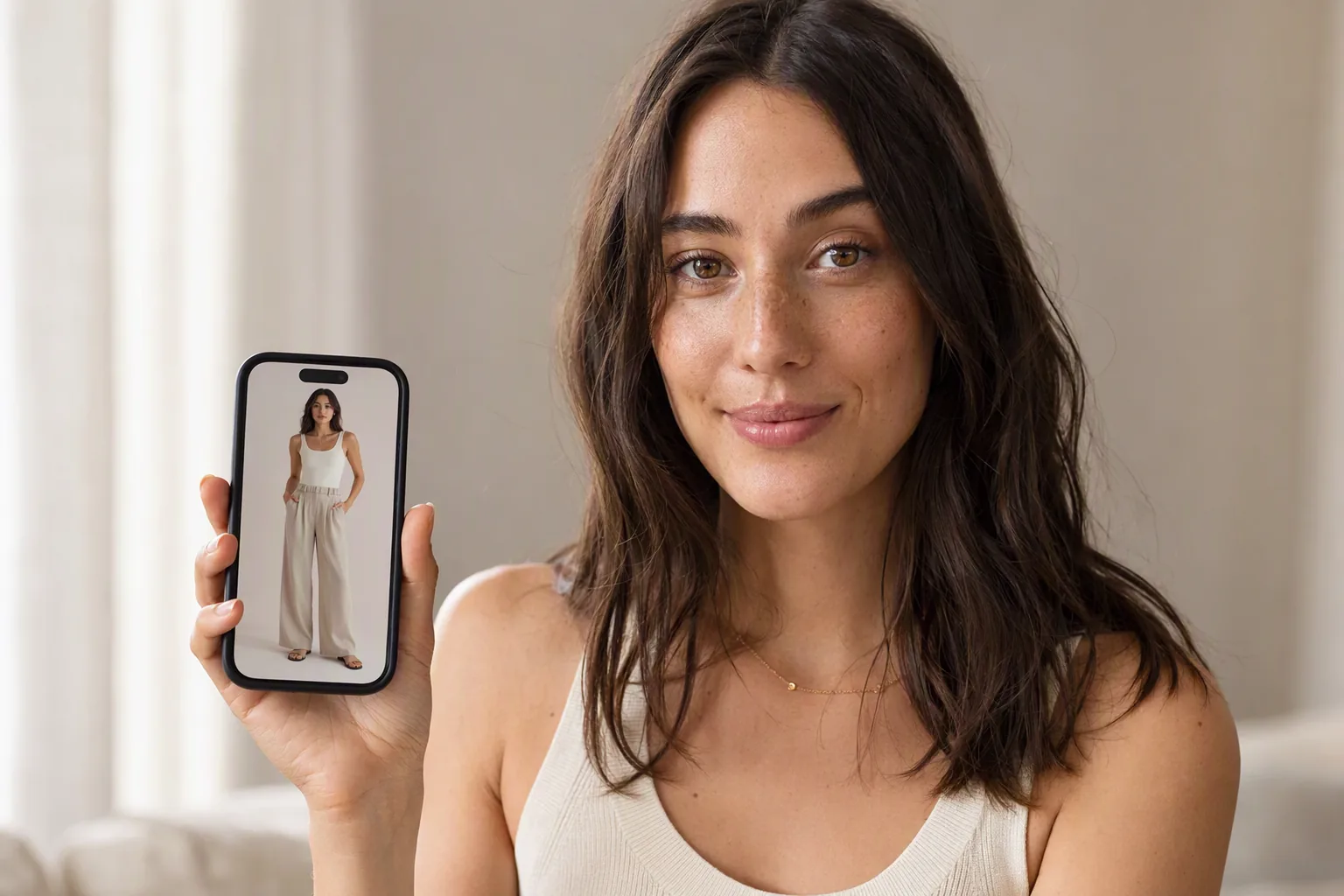
Online shopping has solved many retail problems, but one remains stubbornly unsolved: you cannot try clothes on through a screen. Return rates for online clothing purchases hover around 30 to 40 percent, and the primary reason is fit and appearance mismatches. The dress looked great on the model but completely different on you. The color clashed with your skin tone. The silhouette was not what you expected.
AI virtual try-on technology is changing this by letting you see how clothes look on your actual body before you buy. The same generative AI that powers hairstyle try-on and hair color preview is now being applied to fashion - and the results are remarkably convincing.
How AI Virtual Try-On Technology Works
At its core, AI dress try-on combines several deep learning techniques to create a photorealistic image of you wearing a garment you have never physically touched. Here is how the process works:
- Body detection and pose estimation: The AI analyzes your photo to map your body's shape, proportions, and posture. It identifies key landmarks - shoulders, waist, hips, arms, legs - to understand your unique silhouette.
- Garment segmentation: The target clothing item is isolated and analyzed for its shape, texture, pattern, and physical properties (is it rigid like denim or flowing like silk?).
- Warping and draping: The garment is digitally warped to conform to your body's shape and pose. The AI simulates how fabric would naturally fold, stretch, and drape based on the garment's material properties and your body's contours.
- Rendering and compositing: The warped garment is composited onto your photo with accurate lighting, shadows, and color matching. The result looks like a real photograph of you wearing the outfit.
The entire process takes seconds and produces images that are increasingly difficult to distinguish from actual photographs.
Real-World Use Cases
AI virtual try-on is not just a novelty - it serves practical purposes across multiple scenarios:
Online shopping
The most obvious application. Instead of guessing how a dress, blazer, or pair of jeans will look on you based on a model who does not share your body type, you can see the item on your own photo. This dramatically reduces return rates and increases purchase confidence. Several major retailers have begun integrating AI try-on into their e-commerce platforms, and standalone apps like Visio offer it as a consumer tool.
Event planning
Have a wedding, gala, or job interview coming up? AI try-on lets you experiment with dozens of outfit options from your couch. Test different dress styles, color palettes, and silhouettes to find the perfect look before shopping. This is especially valuable for formal events where the stakes are high and returns are inconvenient.
Fashion exploration
Not everyone lives near diverse retail options. AI try-on democratizes fashion exploration by letting you experiment with styles, designers, and aesthetics that might not be available in your local stores. Want to see how a Korean streetwear look translates to your body? Curious about a maximalist print you would never pick up in a store? Try it virtually, risk-free.
Complete look visualization
Visio's approach is uniquely powerful because it combines outfit try-on with hairstyle and hair color changes. You can see yourself with a new haircut, a new hair color, and a new outfit - all in one image. This holistic preview is invaluable for anyone planning a complete style transformation.
How Visio Implements Virtual Try-On
Visio integrates AI dress try-on as part of its broader photo editing suite. The process is straightforward:
- Upload a full-body or half-body photo.
- Browse available outfit styles and select one that interests you.
- The AI generates a realistic preview of you wearing the outfit within seconds.
- Save, compare, or share your favorites.
Because Visio also offers AI photoshoot modes, you can combine outfit try-on with professional-quality photo generation - seeing yourself in a new outfit with studio-grade lighting and backgrounds.
Accuracy and Limitations
AI virtual try-on has made enormous progress, but honest expectations are important:
What AI try-on does well
- Visual style assessment: Accurately shows how a color, pattern, and silhouette look against your skin tone and body shape.
- Proportional accuracy: Modern models understand body proportions and adjust garment sizing accordingly.
- Fabric behavior: The best systems simulate how different fabrics drape, fold, and reflect light.
- Speed: Results in seconds, allowing rapid comparison of many options.
Current limitations
- Physical fit: AI cannot replicate how tight, loose, or comfortable a garment feels. A dress may look perfect in the preview but feel restrictive in person.
- Complex layering: Outfits with many overlapping layers (jackets over scarves over shirts) are harder to render accurately.
- Unusual poses: Standard front-facing and slight-angle photos produce the best results. Extreme poses or heavy motion blur reduce accuracy.
- Fabric texture: While color and pattern are accurate, the tactile quality of a fabric (softness, weight, stretch) cannot be conveyed visually.
AI Try-On vs AR Try-On
Two technologies are competing in the virtual try-on space, and it helps to understand the distinction:
- AI try-on (photo-based): You upload a static photo, and generative AI creates a new image of you wearing the garment. Higher quality output, more processing time, works with any photo.
- AR try-on (camera-based): Uses your phone's camera to overlay garments in real time as you move. More interactive and immediate, but typically lower fidelity because the rendering must happen in real time.
Both approaches are improving rapidly. AI try-on currently produces more photorealistic results, while AR try-on offers a more interactive experience. Many apps, including Visio, focus on the AI approach for maximum output quality.
The Future of Virtual Fashion
Virtual try-on is still in its early mainstream adoption phase, but the trajectory is clear. Within the next few years, expect:
- Integration with major retailers: More online stores will embed AI try-on directly into product pages.
- Size recommendation: AI will combine visual try-on with body measurement analysis to suggest the best size, not just the best look.
- Social sharing: Trying on outfits and sharing them with friends for feedback - before buying - will become standard shopping behavior.
- Personalized styling: AI will learn your preferences over time and proactively suggest outfits that match your style, body type, and upcoming events.
Try Outfits on Your Photo
Download Visio and see how any outfit looks on you - start your free trial today.


Frequently Asked Questions
How does AI virtual try-on actually work?
AI virtual try-on uses deep learning models to detect your body shape, pose, and proportions in a photo. It then maps a garment onto your image, adjusting for folds, draping, shadows, and how the fabric would naturally fall on your specific body type. The result is a photorealistic composite that looks like you are actually wearing the outfit.
Is AI try-on accurate enough to replace fitting rooms?
For visual style assessment - seeing how a color, silhouette, or pattern looks on you - AI try-on is highly effective. However, it cannot perfectly replicate physical fit details like tightness, stretch, or comfort. Think of it as a powerful first filter: it helps you narrow options before buying, but touching and wearing the fabric still matters for final decisions.
What is the difference between AI try-on and AR try-on?
AR (augmented reality) try-on overlays garments in real time using your phone's camera - you see the outfit on a live video feed of yourself. AI try-on works with static photos, using generative models to create a photorealistic image. AI try-on typically produces higher-quality, more realistic results because it has more processing time, while AR prioritizes speed and real-time interaction.